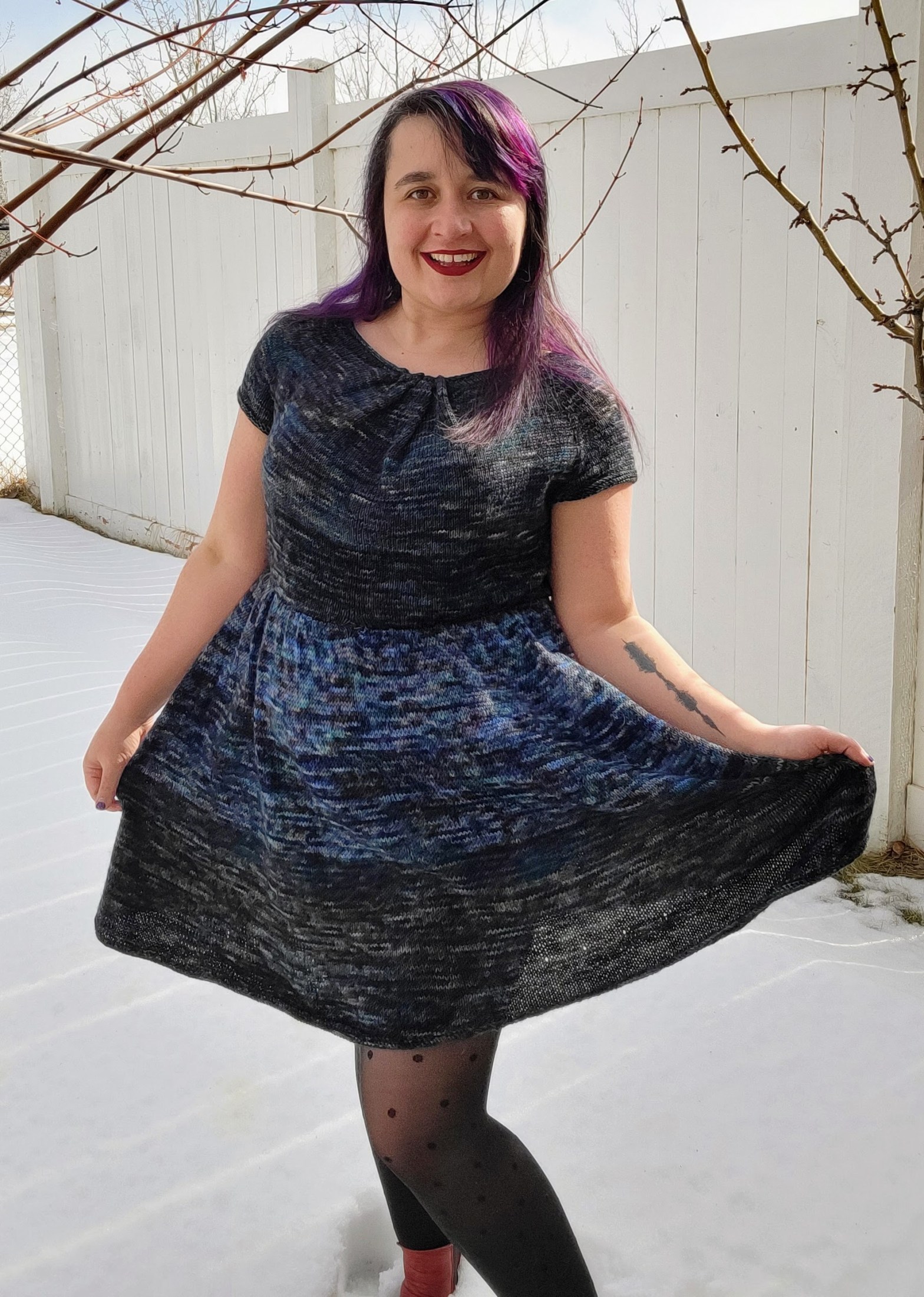
Let this be a word of caution for anyone who wants to knit a dress in fingering-weight yarn.
This all started when I won the Halloween costume contest at my local yarn store, Blackbird Knitting and Needlework. One of my prizes was a skein of their October Bird-of-the-Month yarn, Raven — a gorgeous black-blue-purple variegated colourway inspired by the bird’s iridescent feathers. I had already purchased a few skeins of it earlier that month, so flush with Raven yarn, I wanted to make something impressive.
I had been itching to knit a dress for some time, and there was an abundance of cute, flowy, bouncy dress patterns available. However, a majority were in DK weight, which my Raven yarn was not. It didn’t take long to figure out why fingering-weight yarn was not widely used to knit dresses.
Housedressing is a dress pattern by Chantal Belisle, which she developed in 2017 after knitting the initial dress for her wedding day. It features an A-line silhouette, a gathered neckline, and colourwork around the bottom of the skirt. Super cute.
“Ease” is the metric used to determine the fit of a knitted garment to your body. “Negative ease” means it’s a snug fit (think bodycon), and “positive ease” means it’s to fit loose and baggy. Chantal’s original dress was knit with 0 inches of ease, meaning it fits her exactly — neither tight nor loose.
A few users on Ravelry cited struggles with the sizing, particularly with the top piece. Unfortunately, I was also in that camp. Even with 10 size options, I was coming up in between sizes for my body measurements, and therefore unclear on which measurement I should be paying the most attention to. I acknowledge of course that this is Chantal Belisle’s earliest work (at least according to her Ravelry portfolio), and that I could have reached out and asked her directly, but I did not.
Instead, I opted to soldier on solo, trying on the top constantly, tracking measurements, and seeing where my progress lined up with the instructions given. I ended up with a top that fit my chest but did not hug my waist the way it should have. It was very loose, so to remedy this I wove a black elastic thread through the waist seam and that helped cinch things up a lot.
I also struggled with the skirt. I knew I didn’t want to do colourwork and just knit straight, but trying to knit the skirt from the bottom up was a challenge unto itself. I just could not keep the 540 stitches from twisting around on my needle, and it became unwieldy very quickly.

Instead, I started from the top with a provisional cast-on (so I could still seam the two pieces of the dress together) and knit down, doing increases in place of decreases. It proved to be more manageable for me.
The thing about stockinette stitch is that it is monotonous as all get out, and to do several inches of nothing but knit stitches can be mind-numbing. It was a great project for the days when I wanted to knit without needing to pay close attention to what I was doing. No crazy stitches to keep track of, just keep on knitting on autopilot.
When I finally cast off after four months of work, I was ecstatic. I didn’t anticipate the challenges that this dress presented, but that’s the thing about knitting — sometimes you don’t know what’s coming until it’s on your needles.
Even with the unexpected hurdles, I am in love with the finished product. The skirt is flowy, the drape is fabulous, and it shows off the beautiful hand-dyed yarn perfectly.
While I am very happy with the finished product, knitting a dress is not for the faint of heart or weak of will.
This truly is amazing. The dress is adorable! Love you.
<
div dir=”ltr”>
<
blockquote type=”cite”>
The dress looks beautiful on you and even if it took a lot of time and I think the end results showed through for sure. Gorgeous dress, gorgeous you <3
That neckline on the dress is lovely! And you look so pleased with the finished dress!