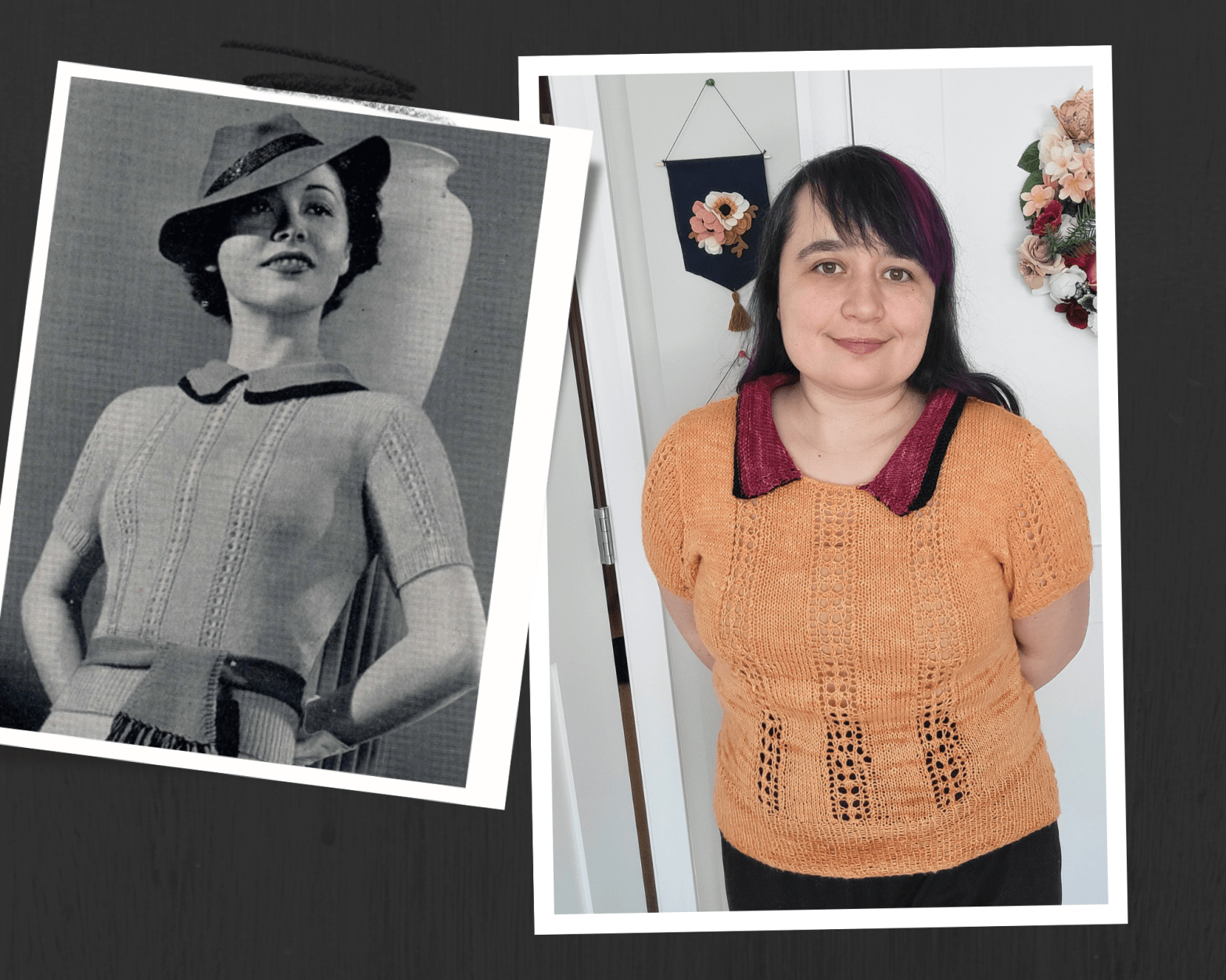
Welcome to a new series on my blog, where we will travel back in time to discover knitting trends and patterns from the past by knitting with them in the present.
Knitting has been around for as long as humans have, so I truly had my pick of where to begin with this series. I chose the 1930s because it was the earliest example of knitting patterns in my growing collection, and because the Great Depression led to a boom of knitting for necessity in a time of scarcity.
The Great Depression hit the world’s economy hard, and Canada was no exception to its effects. In 1933, Canada’s unemployment rate rose to 20%. With limited resources, people often turned to knitting their own clothes, as in some cases it was more affordable to buy a few balls of yarn for 20¢ each ($4.17 each in today’s money) and make something from scratch than to buy a new garment.
The pattern I chose to follow came from Monarch Knitting Company. Once a titan of Canada’s textile industry, Monarch produced premade knitwear and hosiery, as well as yarn and patterns. It’s bittersweet to look into newspaper archives and see how much Canada’s economy has changed — how our country once had a considerable piece of the textile industry that has mostly gone overseas. Even during the Great Depression, Monarch and its shareholders managed to scrape by and turn a profit, even if it was a meager one some years. Sadly, Monarch closed down in 1963.

The 1937 Spring/Summer issue of Monarch’s pattern magazines boasted the new “tailleur look,” form-fitting pieces — especially multi-piece sets — made with light yarn and delicate-yet-simple stitches in bright colours. The pattern I chose was The New Yorker, a snazzy lace-knit blouse with a Peter Pan collar. “A tonic to brighten the old wardrobe and inspiration to start the new!” so says the opening letter.
The first thing that threw me off was the formatting. In today’s pattern books, all the photos and instructions are kept together for each pattern. But the 1937 standard layout was more akin to a scavenger hunt, where instructions and photos would be hacked apart and put in a haphazard order (for example, the photo for The New Yorker was on page 24, half of the instructions on page 23, and the other half on page 34, all parts sharing space with a hodgepodge of other pattern segments — chaotic at best, inefficient at worst). I ended up printing out the individual pages from the booklet so that I could keep better track of the instructions I was meant to follow, lest I accidentally knit from the wrong pattern.
When it came down to choosing yarn, I wanted to follow the colours suggested in the pattern. However, since Monarch doesn’t exist anymore, I had to find my own way. Peach was the main colour, with accents of black and “Cherry Rose” (which I took to be a reddish magenta, like the flower). Peach is even the Pantone colour of the year in 2024, proving that all trends are cyclical.
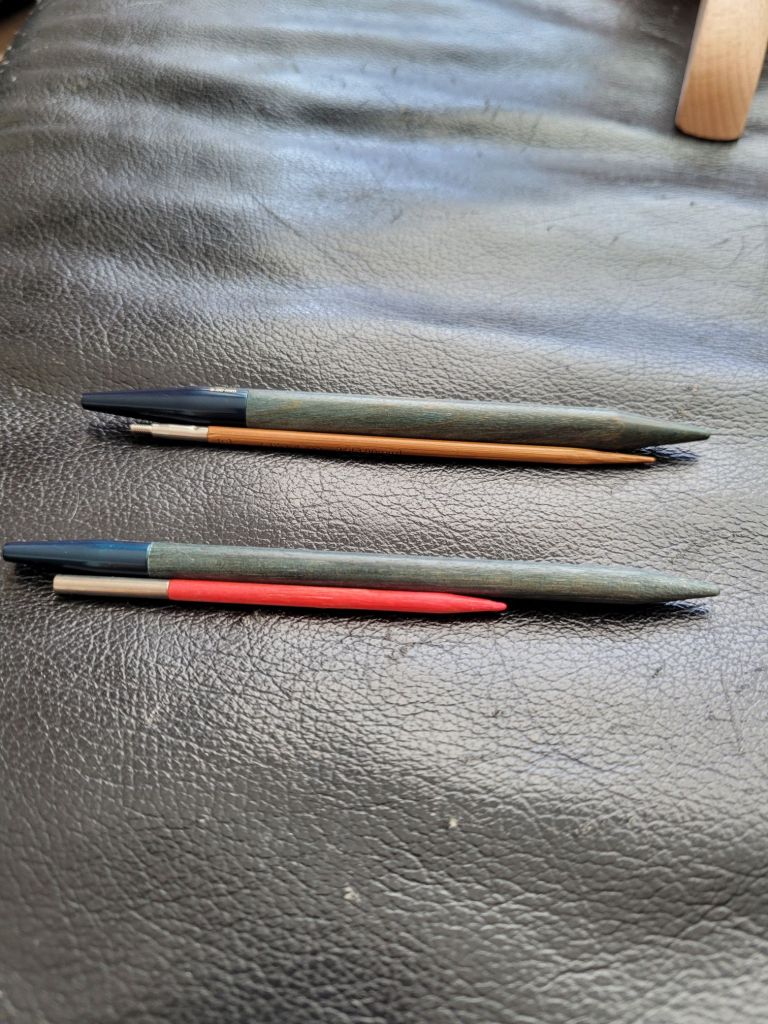
The next hurdle came when I saw the needle sizes. In modern Canadian patterns, the standard is a US numerical size, followed by the needle’s circumference in millimetres (eg: US 0, 2mm), small numbers mean small needles, and big numbers mean big needles. That makes logical sense.
Which is why I was taken aback when the pattern called for a “Numbers 10 and 11” needle to knit fingering weight yarn with. A US 10 is huge! It would never work with yarn as thin as fingering weight. It took some digging before I understood that these old patterns used British needle sizes — which assign big numbers to small needles and the size numbers go down as the needle circumference goes up (eg: UK 19 is equal to a US 0). I was actually going to need 3.25 mm and 3 mm needles. And balance is restored to the universe.
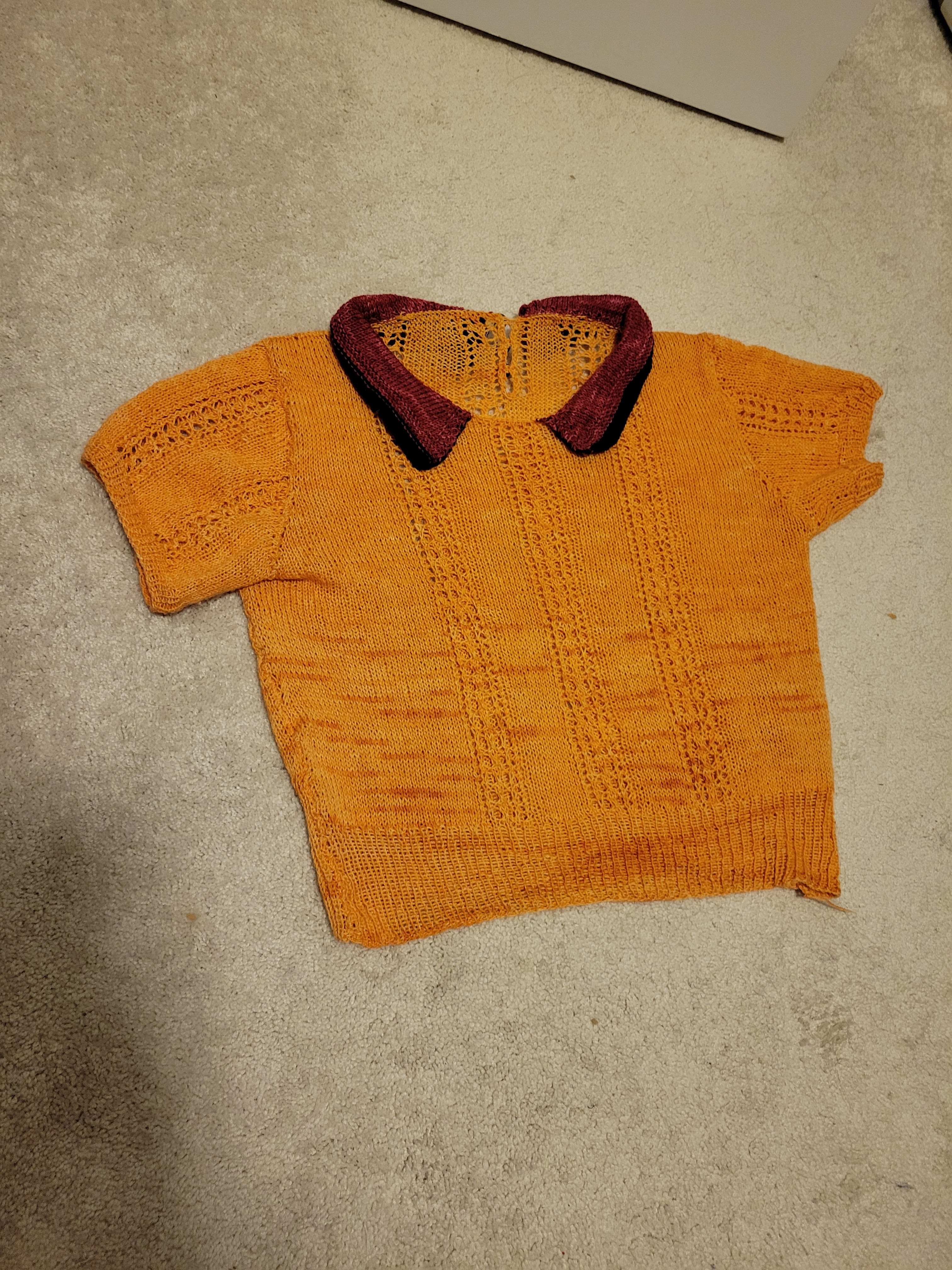
Knitting the lace columns became quite meditative after a while, it was a simple four-row repeat across the front panel, back, and sleeves that was easy to memorize. The collar was knit in two identical pieces — one Cherry Rose and one black — on each side and seamed together. It was one of my first times knitting a folded collar like this, and it was perfect for capturing the vintageness of the piece, as the rounded collar (and collars in general) really was in its heyday at the time of the pattern’s release.
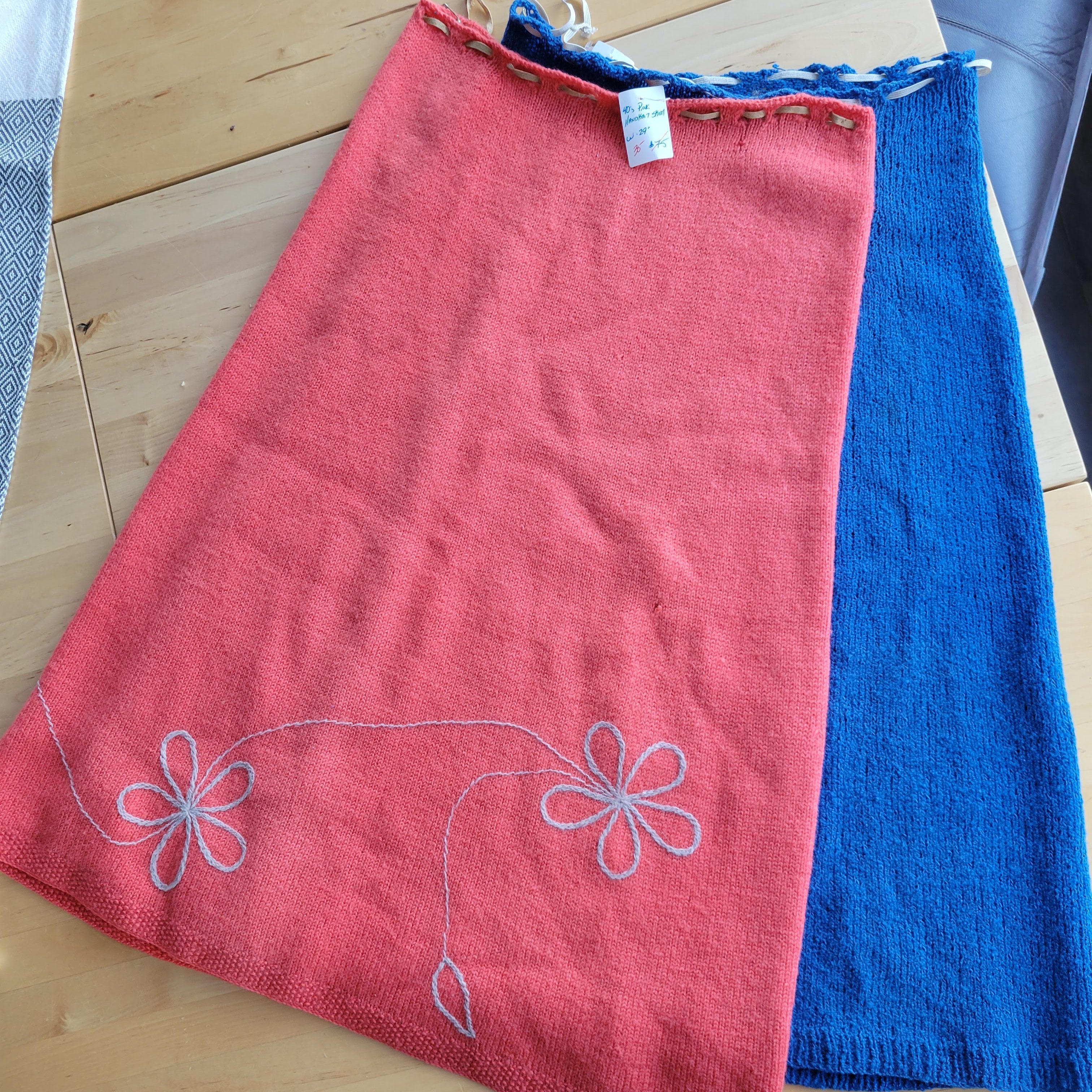
The pattern also included a matching skirt and a girdle (a two-toned scarflike belt that matched the collar), but since it already took me so long to knit the blouse, I decided to stop here for now. Maybe I will complete the ensemble later. I lucked out at Swish Vintage in Edmonton and found two hand-knit skirts from around the ’30s or ’40s that I can use for a historically-accurate pairing anyway!
Ironically, I was first led to believe that this pattern was from around 1941, per a collection of scans from an archival website, Wartime Canada. The scanned booklet was missing a few pages (including the cover and anything with a concrete date). Wartime Canada is maintained by a legion of historians, professors, and students out of the University of Western Ontario, so I trusted their estimation.
However, as I delved deeper into my research, I learned that Monarch slowed production on yarns that weren’t soldier-approved navy blue, khaki, grey, and black during World War II until 1945. So it seemed anachronistic for a yarn company to put out a pattern book that exclusively used super-colourful yarns that weren’t in production.
As such, I wondered if maybe it was from 1945 onward. The patterns were numbered sequentially (700-723), so I thought I would have some luck estimating the date based on that. I was hoping to at least find numbered patterns close to this range that I could make an estimate from, but as luck would have it on March 3, 2024 (literally days ago as of writing this), a seller on Etsy listed a PDF of the exact same booklet in its entirety, which is how I learned that my vintage knitting series was actually starting pre-war.
It was only two years after this pattern came out when the world would see another earth-shattering historical event, one in which knitting had also played an important role. We will look at that in the next installment of A Stitch in Time.
Love this article and the play on words..a stitch in time. So creative and having the history of knitting is going to be an interesting journey I look forward to reading ❤