
I was nine years old when I saw my first dead body.
Picture this: it’s March 2004, and for reasons that still remain a mystery, your Grade 4 class is heading to the Glenbow Museum to check out a touring exhibit of Bog Bodies — human remains preserved by European peat bogs with alarming quality for hundreds, even thousands of years.
I don’t know what our teachers were thinking. It wasn’t related to anything in our curriculum, and we were much too young and unprepared for what we were going to see that day. I remember being too scared to even look around the room, lest my eyes fall upon another disfigured, leathery corpse. My dad volunteered to chaperone that field trip, and to this day he remembers the death grip one of my classmates had on his hand. In fact, here’s a page from my school journal reflecting on that field trip for my teacher:
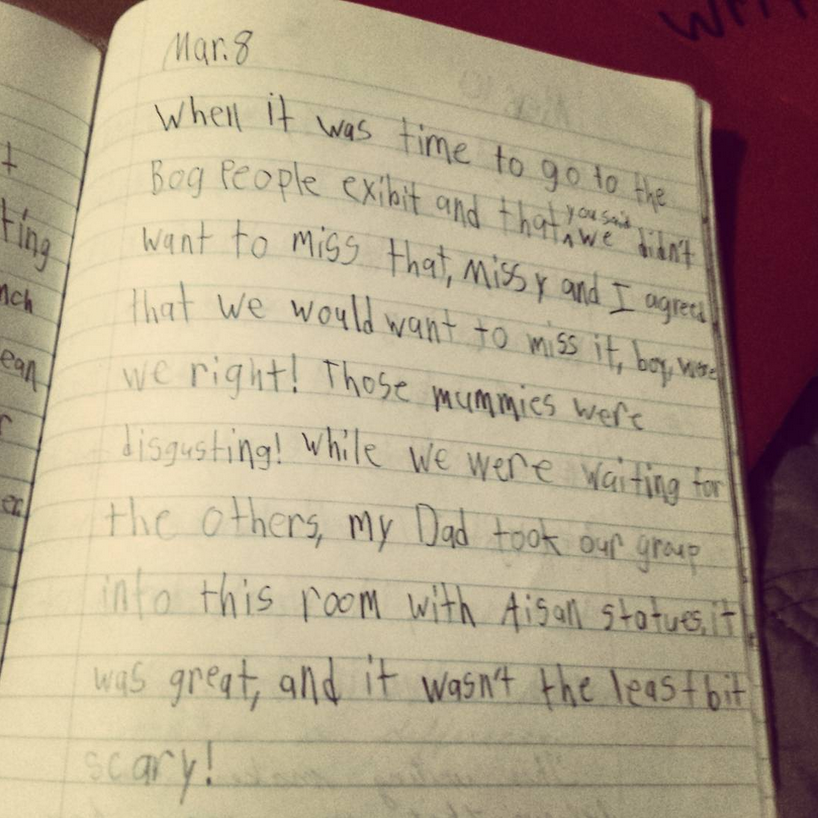
Today, as a full-fledged adult and museum aficionado, the bog bodies bring a morbid fascination. Not only were their bodies preserved by the combination of cold, acidity, and organisms in the environment, but their clothes, belongings, and even stomach contents as well. It gives us a unique and detailed glimpse at life from centuries ago.
The Arnish Moor Man was discovered in a peat bog on the Isle of Lewis off the coast of Scotland in 1964. The brothers who found the body called the police, thinking it was a recent homicide, but analysis of the man’s clothing and belongings suggested he was alive in the early 1700s. He was found wearing a woven plaid jacket, hand-sewn leggings, and a floppy knitted bonnet that was so perfectly preserved, I wondered if I could recreate it from scratch. So I did.

Thanks to an extremely detailed report published by the Society of Antiquaries of Scotland in 1974 by Helen Bennett, as well as several recent close-up videos and photos posted by the National Museums of Scotland highlighting the Arnish Moor Man’s ensemble, I was able to lay the foundation of this ambitious project with ease.
Helen Bennett’s report stated that the band was cast on first, 85 stitches, folded double, and increased to 200 stitches at the widest point before gradually decreasing to 12 stitches at the crown. I scrutinized this video from National Museum Scotland’s social media of the bonnet, and because the stitches were still so well-defined despite two centuries in muck, I estimated that the increases were approximately every five rows, and every five stitches, based on where I could see the increases on the original piece.
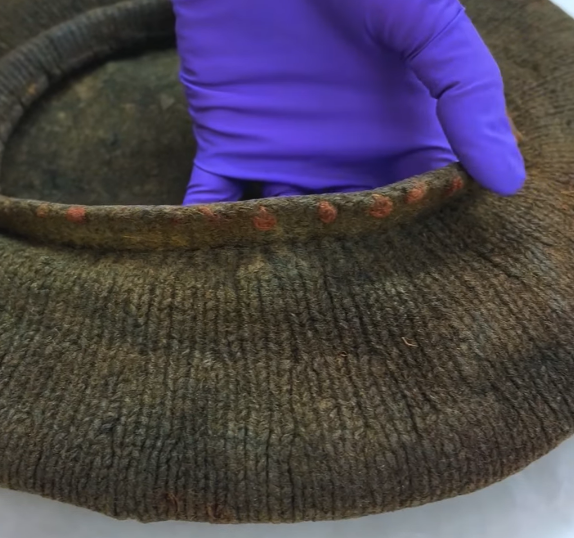
Forensic dye analysis of the hat determined that, while it was turned brownish-green by the bog, the hat was dyed with indigo and was likely originally a deep blue hue. The hat also featured “dots” of red along the edge of the hat band, which to me looked like bobble stitches, evenly spaced around the fold. The double band also helped hide the floats between the bobbles.
Wanting to remain as true to the hat’s origins as I could, I ordered yarn directly from Scotland — The Croft DK Shetland wool in blue and red tones — from Jamieson & Smith, a wool shop and brokerage based in Shetland, just 580-odd kilometres from the Isle of Lewis where the Arnish Moor Man was found. It was my first time working with Shetland wool, and I didn’t know what to expect, especially with it coming from abroad and not being able to touch it until it arrived. I found the Shetland to be pleasantly squishy, and a good midpoint between hardy and soft yarn.
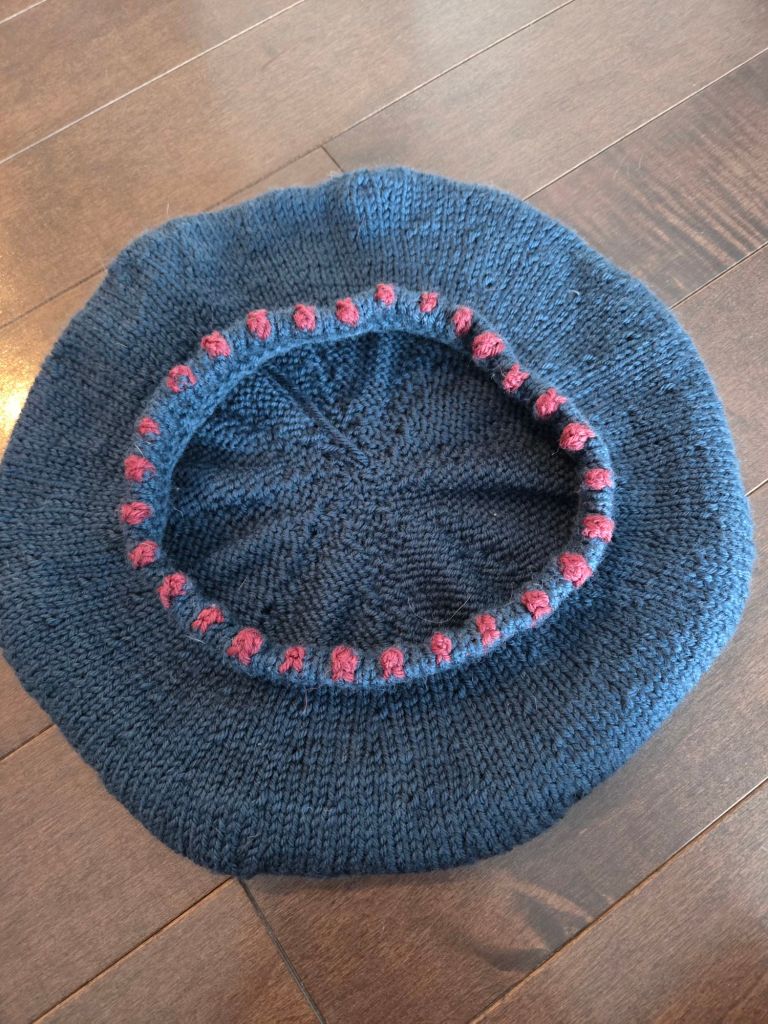
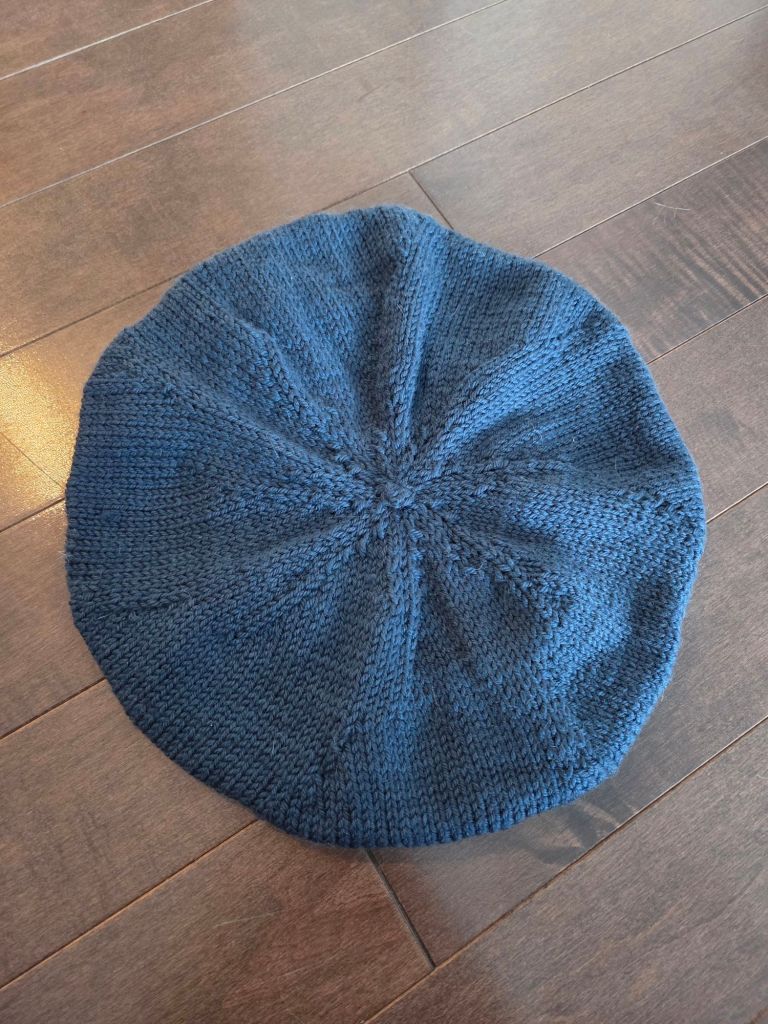
The finished bonnet is still stylish by today’s standards, with thoughtful design, embellishments, and bold colour choices. A far cry from the drab fashions that people typically associate with peasantry.
As I worked on this hat, I couldn’t help thinking about the young man who wore the original. He was roughly 20 when he died from a blow to the back of the skull. The leading theory is that he was murdered, but we can never know for sure. His clothes were well-worn and mended, and it’s bittersweet to imagine the hands that made and repaired his clothes for him. We don’t even know his name.
The Arnish Moor Man’s belongings are currently on display at the Kinloch Historical Society in Balallan, a mere 16 kilometres from where his body was exhumed from the peat.
What an interesting, thoughtful project! You did a beautiful job of it.
Your hat turned out terrific. Hopefully a happy ending to an unpleasant experience.
This was fascinating, thank you for sharing both the story of the Arnish Moor Man and your replica bonnet