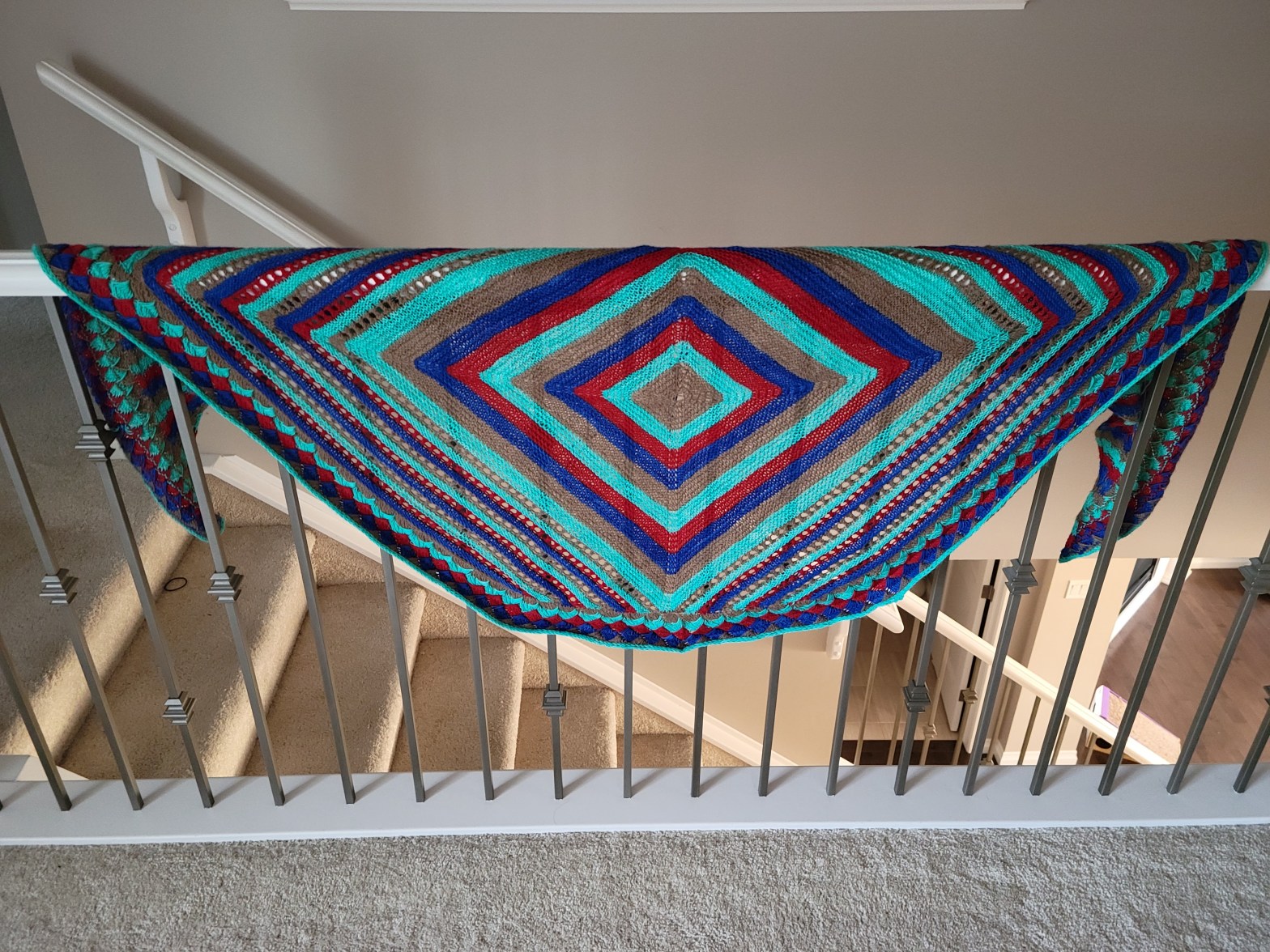
The eccentric knitwear designer Stephen West launches a shawl pattern as a Mystery Knitalong (MKAL) every October. This year’s Geogradient shawl was his 14th MKAL and my second time participating.
What makes a Mystery Knitalong a mystery is that the pattern is released in bits and pieces over a set period (in West’s case, every week for four weeks). You’re not just buying a knitting pattern but also the experience of the unknown; and for a Stephen West mystery pattern, there’s usually some amount of complex and unusual stitches to learn, with lots of vibrant colours throughout.
The name “Geogradient” is a portmanteau of “geometric” and “gradient.” We were told to pick out four yarns, which didn’t have to be from the same colour family, but we had to follow a range from light to dark shades, with Colour A being the lightest and Colour D being the darkest. Hence the gradient.
When I heard the name, my mind didn’t go to “geometric” but to “geode.” But then again, I love rocks, gems, and fossils, so it made sense why my brain made that connection. As such, when I chose my yarn colours, I looked to geodes (Thunder Egg Agate in particular) for inspiration. My gradient comprised a neutral beige (like the exterior of a geode), turquoise, deep red, and dark royal blue.


The “geometric” part of the name comes from the zany geometric shapes found in 1970s wallpaper designs, from which West took inspiration when creating his pattern.
The first of the four clues was released on October 5, and I spent my morning before work following along with West’s video tutorial, working up a twisty-turny square of lines and triangles that would be the centre of the shawl. I was about halfway through when I began to worry that the pattern was starting to look a little… off. It turns out I wasn’t the only one, as several others also noted that what was intended to be a pinwheel-like design bore an accidental resemblance to a hate symbol.
West handled the whole situation with care and grace. He took swift action to delist the original pattern and release an updated version of both the written instructions and the video tutorial, swapping the centre design out for a series of concentric squares. “We’re going to knit empathy and kindness and respect into every stitch,” he reiterated on all his social media channels.
The redesigned Clue 1 had us knitting from the centre of the square out, expanding from a tiny circumference of stitches into bigger and bigger stripes. It was a simpler motif, yes, but a pretty one nonetheless. It was a great project to take with me on the go as well since the row repeats were much easier to commit to memory.
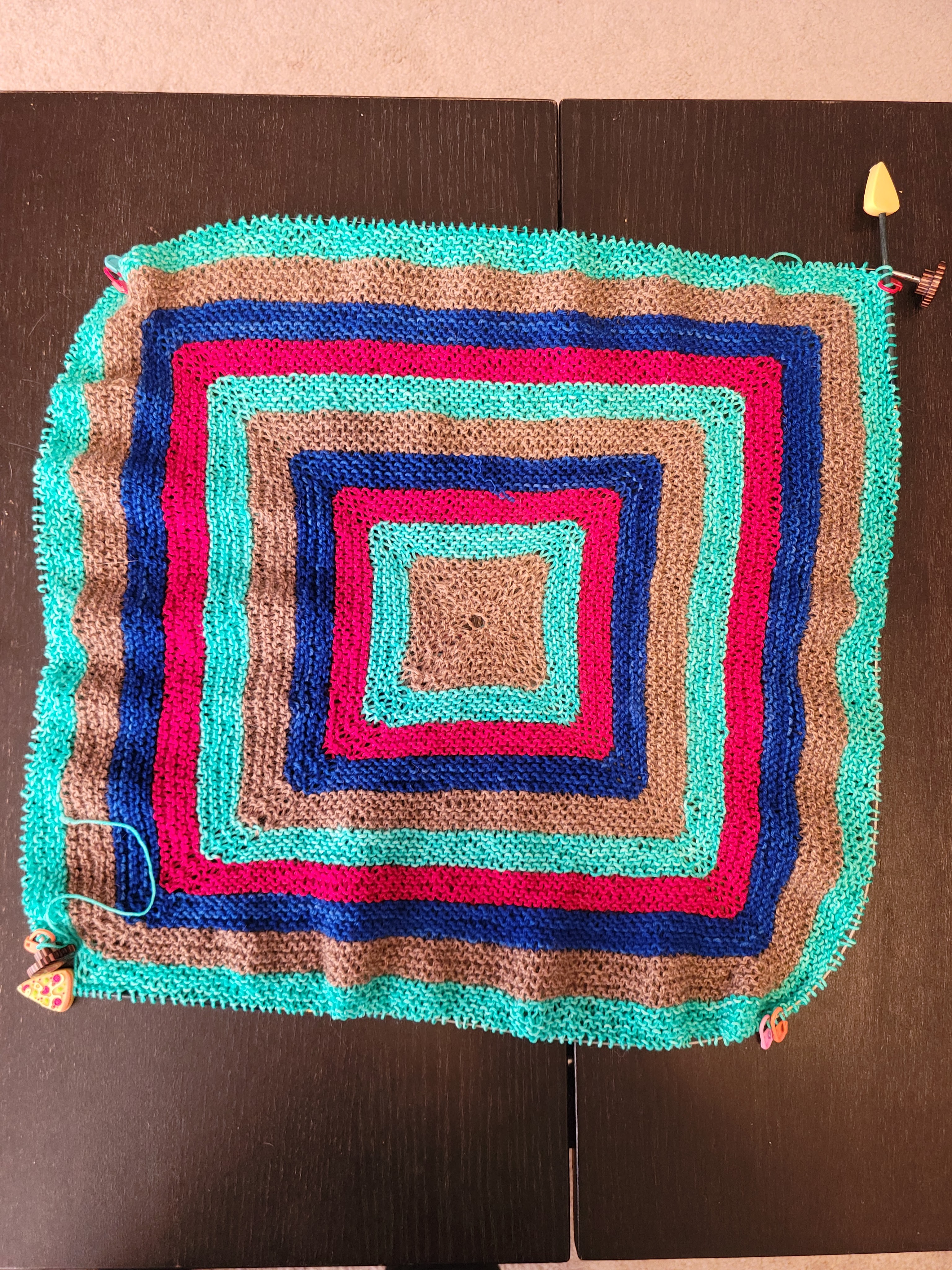
Clue 2 debuted the following Thursday, and the complexity was ramping up fast, with alternating ridges of garter stitch and stripes of eyelets, stretching the shawl into an oblong eyeball shape. A simple technique, but one that took ages as the size of the project increased row by row.

When I finally caught up to the progression of the MKAL, Clue 3 had already been out for several days. If my previous experience with the Shawlography MKAL back in 2021 was anything to go on, Clue 3 was going to be when stuff got real.
And boy did it ever.
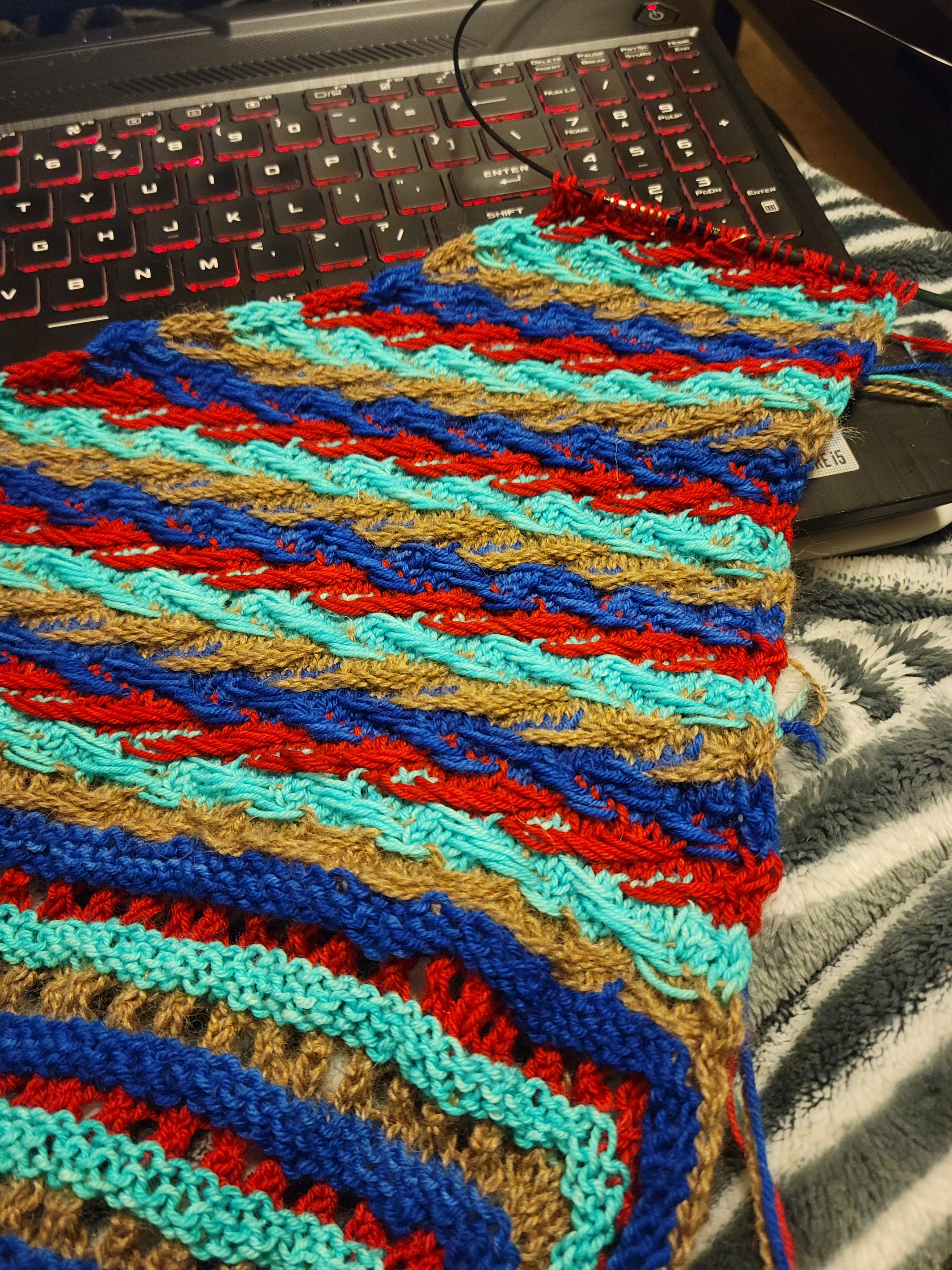
Clue 3’s motif was staggered rows of slipped stitches, which created a zigzag effect, which gradually decreased to a triangular point on each side of the shawl. It was a beautiful design to be sure, but one that you had to pay close attention to. Mess up one row and you risk ruining the effect through the whole section.
I combatted this by putting the instructions into an Excel spreadsheet so I could keep track of the repeats, decreases, and what colours were assigned to each stripe. Being able to visualize what section I was on really helped me out.
It took absolutely ages, though. When the finale, Clue 4, came out on October 26, I had just barely reached the halfway point of Clue 3 as people were showing off their finished shawls (seriously, how do y’all knit so fast?!) But I knew it wasn’t a race, and that I’d finish when I was meant to.
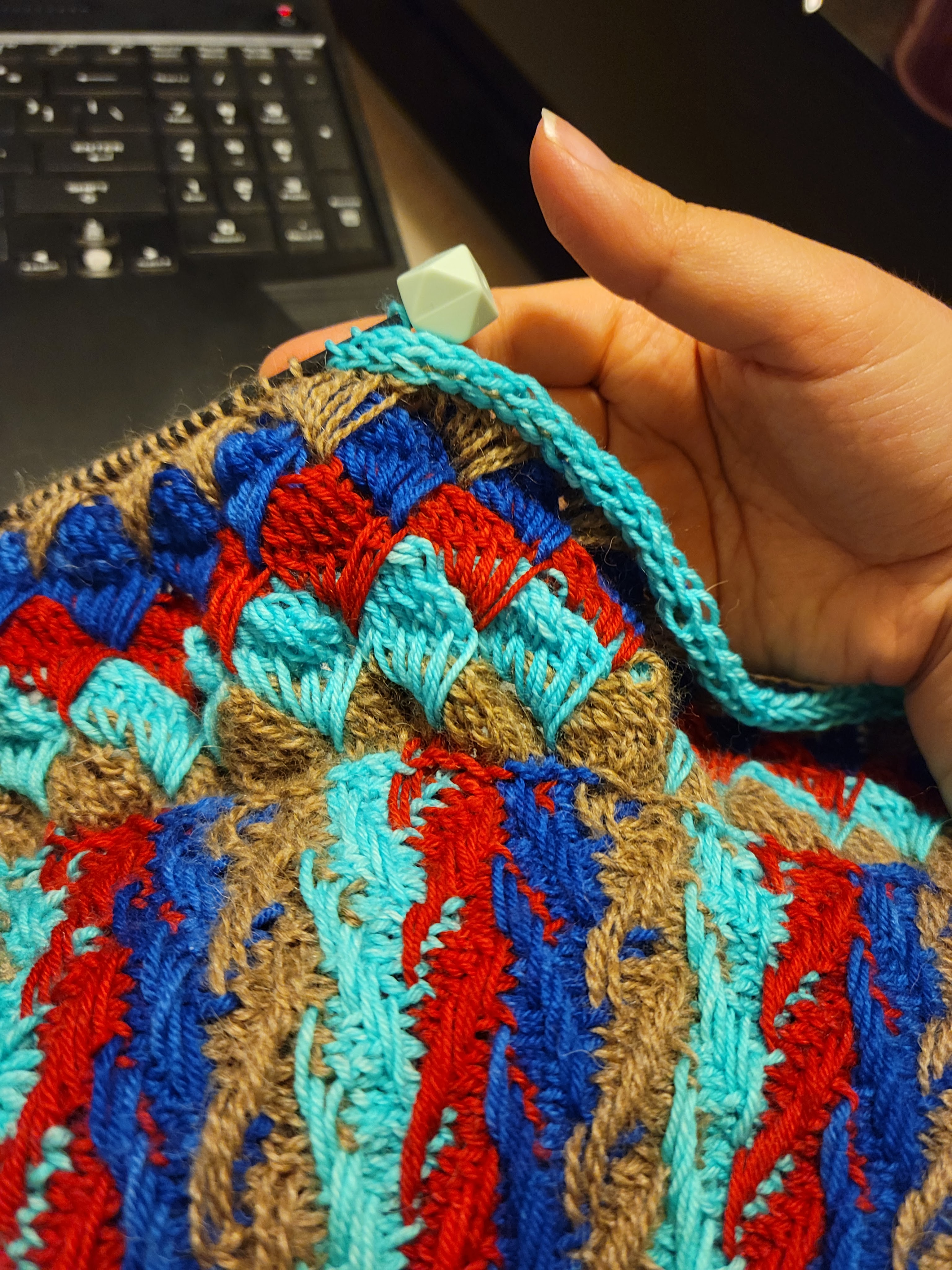
Clue 4 finished off the shawl with another fancy stitch motif, the Dip Stitch, which turned rows of basic stockinette stitch into diamonds by knitting into the rows below. It was a surprisingly meditative process, and even though some of my diamonds got a little wonky when I knit into the wrong stitches, I really enjoyed this new technique. It seems that West is too, as a bunch of the new patterns he’s come out with since include the Dip Stitch.
The whole shawl was finished off with an i-cord bindoff. I don’t think it would be a Stephen West pattern without it. But oh my good grief, doing that bindoff for more than 500 stitches was agonizing. The i-cord method takes up a lot more time and yarn than a standard bindoff, since it’s significantly more involved. It legitimately took me a collective three hours. I finished the shawl on November 12 and gave my poor hands a much-needed rest.
I saw a lot of people concerned that the change in Clue 1 would leave them with not enough yarn to finish the shawl but that was not my experience. I managed to salvage a lot of the bits of yarn from the original Clue 1 to use throughout the shawl, and I had a lot of yarn left over.
In all, the shawl is gorgeous, and it’s the kind of massive drapey piece that I love.
Gorgeous! I saw it in person and the vibrancy of the colours matches your personality! Beautiful <3
Love your choice of colours and the story behind you choosing them!