
After the abject horror that was carding by hand, imagine my surprise and relief to find that I thoroughly enjoy spinning.
In preparation for this step, I began researching the various spindles and spinning wheels on the market and found that, much like carding, the ratio of equipment cost to material-processing capacity is quite staggering. In an ideal world, I would have sprung for a spinning wheel due to the sheer (or rather shear, heh) volume of wool I had on hand. However, spinning wheels go for around $1,000 new. Man, spinning has quite the upfront cost.
Instead, I went for a Schacht Hi-Lo drop spindle, as it was highly recommended for beginners and also considerably more cost-effective. Plus, they had a really handy video tutorial on their website on how to get started.
Drop spindles are kind of shaped like spinning tops with a metal hook on one end and a long rod on the other. These handheld spindles use centripetal force to spin fibre into yarn, and the thickness of the finished product relies on the amount of fibre and velocity of the spin.
While I did get the hang of it quickly, I’m still figuring out how much space to give between the twisted fibre and where I’m feeding the fibre in (also known as the ‘draft’), as if you let your twist go too far towards the end of your fibre it makes it really hard to spin.
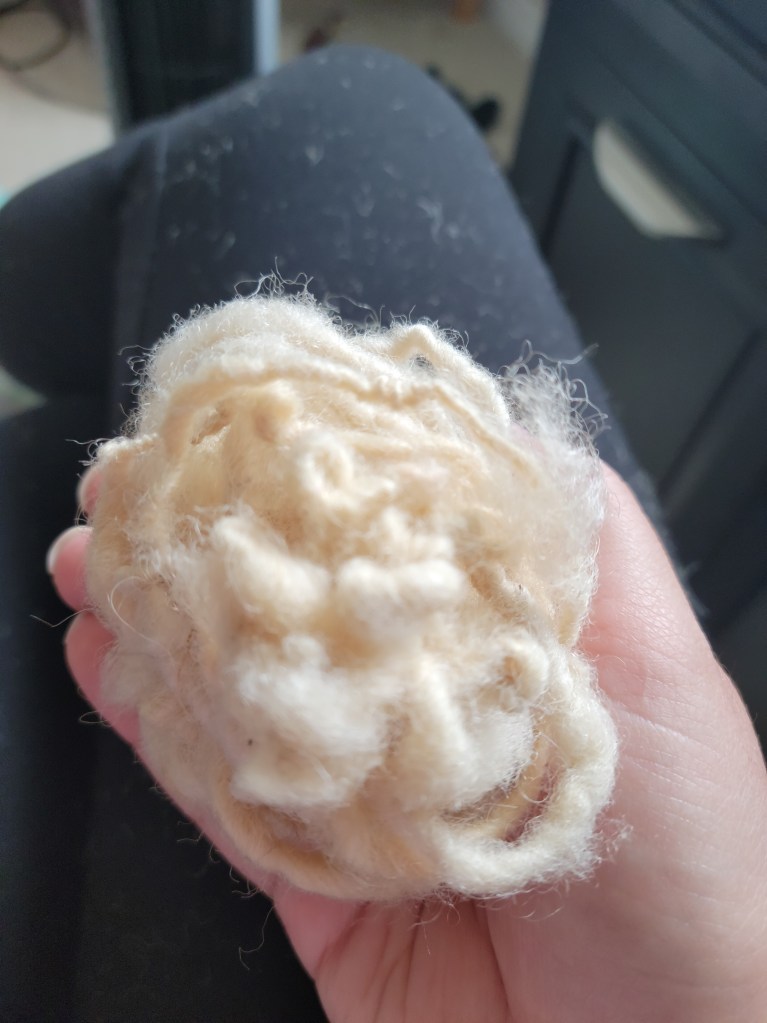
My end result appears to be a thick-and-thin bulky yarn, which I’m really digging, and would make a beautiful toque or cowl. I hope to eventually get to a point where I’m able to maintain the same consistency throughout. It’s a lot of fun and deeply satisfying to watch the fibre twist up into a recognizably yarn-like shape!
To read all the installments of the Abandoned Bus Chronicles, click here.