
The 1960s were an iconic era for fashion, social change, and counterculture.
Of all the decades so far in my series, this is certainly the most stylistically diverse for knitwear. From Jackie Kennedy-inspired capes to beatnik turtlenecks and flowy hippie garb, the ’60s were a turning point where knits weren’t just utility, but a creative medium for art, self-expression, and fashion.
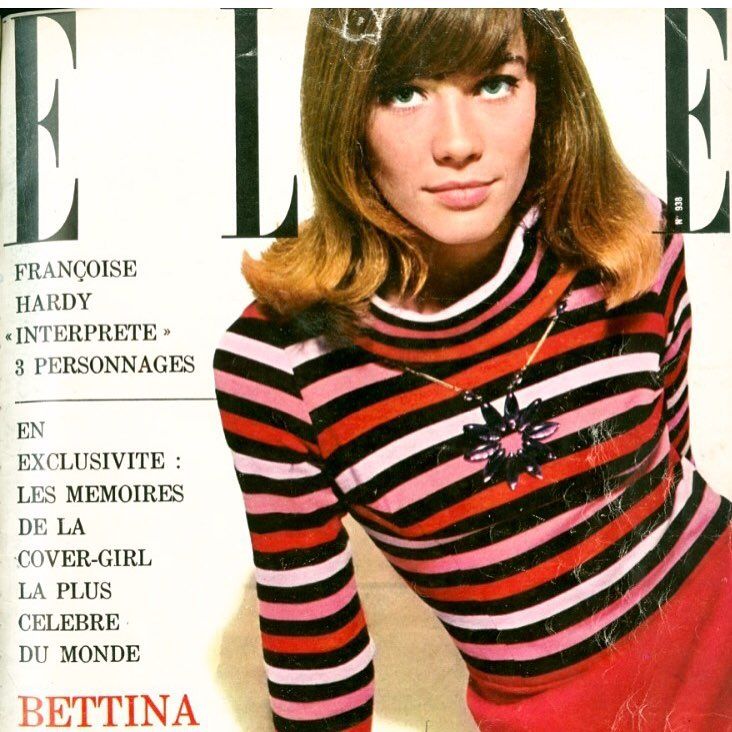
French fashion designer Sonia Rykiel, dubbed the Queen of Knitwear, made a splash on the scene with her “Poor Boy Sweater,” a close-fitting striped ensemble on the December 1963 cover of Elle Magazine in France. Audrey Hepburn allegedly bought five Poor Boy sweaters in different colours after seeing this cover.
Then there was Mary Walker Phillips, a textile artist from Fresno, California who came onto the scene in 1964. She became known for using unusual materials like hair, fibreglass, paper, tape, in addition to standard textiles like linen and silk. Her woven upholstery, tie-dyed blankets, wall hangings, rugs and knitted sculptures are still in museum collections around the United States today. This tapestry, for example, is in the Smithsonian:

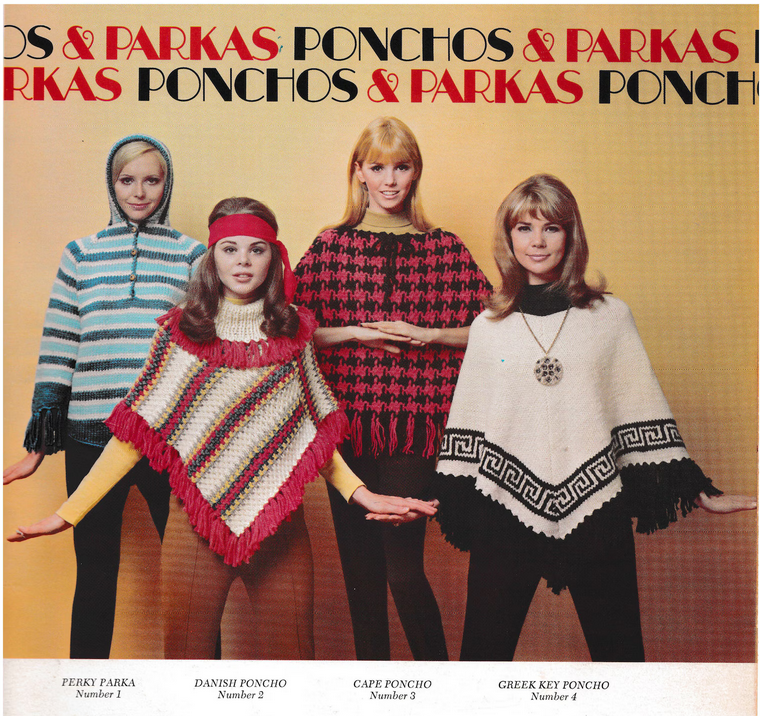
Despite the fact that hippie culture didn’t surface until the tail end of the 1960s, it has become emblematic of the entire decade, so I chose a very flower-child-friendly poncho pattern to follow. The Danish Poncho is part of a set of knit and crochet ponchos and parkas produced by yarn manufacturer Columbia-Minerva in 1968 (later republished in 1973), featuring a five-colour repeat and fringe galore.
Anti-consumerism counterculture was bubbling up in the late ’60s, fuelling a DIY Revolution. Crochet and macrame were especially popular for clothing and home decor, and clothes were modified with everything from leather to beads, and patches to embroidery.
In the spirit of that scrappy attitude (pun intended), I sourced all the yarn for my project secondhand, “shopping” from a friend’s vast yarn stash for five colours: white, grey, blue, yellow, and red. And when I was done, I passed the leftovers onto another friend to keep the train going.
Crochet was booming in the era, but since I don’t know how to do the craft itself, I chose a pattern that at least somewhat emulated the crochet texture with alternating sections of slip stitches and garter ridges. Besides, I did need a crochet hook to do the fringe all around the edges! I made a couple of changes to the collar when I ran out of the white yarn (the one challenge with secondhand). I used the grey instead, and since I thought the red fringe would not complement it the same way, I left the collar fringeless.
I put off this project for almost a year, as I was dead tired of knitting things flat — the poncho was made by joining two identical rectangles, long edges to short edges. It felt a lot more tedious at first before I found a rhythm. This is also the first time I’ve ever used US 15 needles, and the sheer size took some time to adjust to. I’m glad I persevered, because it was a perfect lazy Halloween costume! And it looked right at home on my latest visit to Repeat Vintage in Edmonton:
