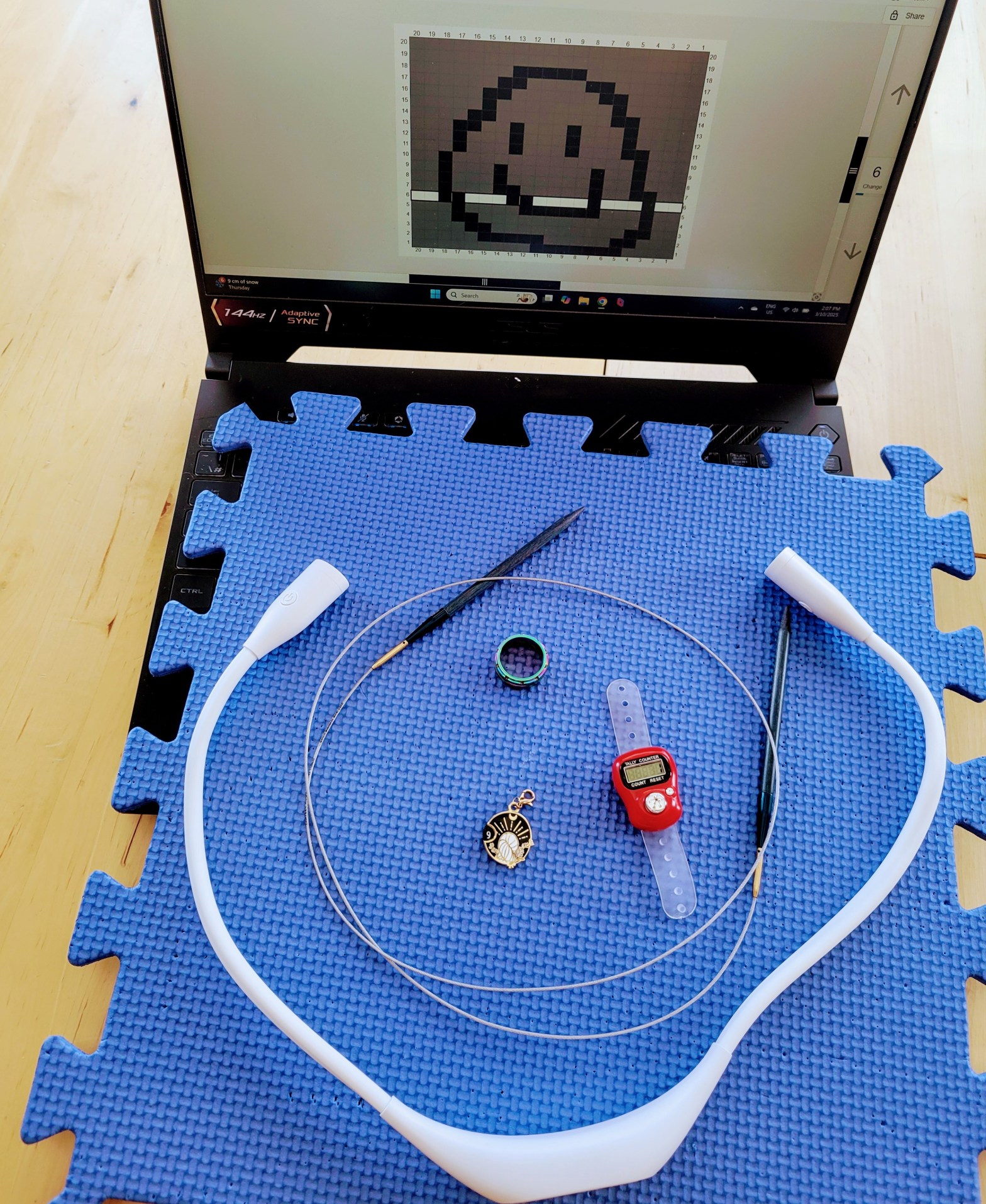
I truly believe that fibre arts make you resourceful. Over the years that I’ve spent obsessively knitting, I have accumulated a lot of problem-solving tricks and tools to hack the system.
Reformatting: A lot of knitting patterns have their own style when it comes to layouts, but it doesn’t always work for me. It blew my mind when I realized that I could take a pattern’s instructions and rework it in a plain Word document so that the instructions were easier for me to read. Minor tweaks like breaking up big blocks of text into line-by-line instructions and copy-pasting repeat sections so I can keep better track of where I’m at has made a tremendous difference.
Stich Fiddle and Chart Minder: I struggled with interpreting charts in knitting patterns for a long time. Trying to keep my place on the grid felt impossible, I would often lose track of what row I was on, what stitch, or what direction I should be reading it in. I tried using sticky notes, printing it out, crossing off finished lines, but nothing really helped. That’s when I discovered web-based tools like Stitch Fiddle and Chart Minder, two similarly-suited websites that allow you to scan, convert, and write your own charts.
I have learned how to transpose charts (of both colourwork and stitch patterns) from PDFs and books into these programs, and it’s made chart-reading so much more accessible. I especially like that with the progress tracker, all the lines are greyed out except for my current row.
Spreadsheets: I like to say that knitting is just math in a trench coat, and my math skills are mediocre at best. Excel and Google Sheets are excellent (pun absolutely intended) resources for keeping track of project progress. I use basic addition and subtraction formulas to track remaining increases or decreases, and colour-coding formulas for row repeats.
Children’s playmats: Foam “blocking mats” for pinning finished projects to can easily go for ~$100 a pop, which is complete nonsense when they’re basically the same thing as interlocking playmats for kids. I can get a four-pack of those for three bucks at the dollar store, and they’ve worked just as well!
Swivel cords: I use interchangeable circular needles almost exclusively these days. These are modular needles that come with a range of needle tip sizes and cord lengths that screw together. My first set, Lykke Indigo, came with black fixed cords that annoyed me to no end. Especially when changing needle tips on a project or any other time where I was screwing something onto the cord, the whole cord would rotate wildly.
Swivel cords are made so that the screw ends rotate independently, and are not fused to the cord. I eventually replaced all my Lykke cords with ones from Lantern Moon, as I prefer their carbon fibre material, and they are still compatible with Lykke needle tips.
Row counters: Rings, clickers, stitch markers, and more have been made into tools for counting. At the beginning of my knitting journey, I often used apps and websites to count rows, but have since found that I prefer using something more tactile in this case. I like to use my row-counter bracelet for counts of 10 or below, and my rings for greater quantities.
Neck light: Sometimes, I can’t be bothered to get up and turn the light on when I’m knitting after the sun goes down. This is where adjustable neck-mounted lights come in clutch. Lumos’s Instagram ad campaign worked on me, and I asked my husband to get me one for my birthday last summer. It’s also handy for increasing visibility of stitches in dark yarn!
I will try out your recommended chart programs. I use Knit Companion. I’m currently working on a chart that has 300 stitches and it doesn’t have a smaller repeat. I need a chart that can easily display 300 stitches per row. My favorite row counters are the ones by Twice Sheared Sheep. Since they replace a stitch marker, I don’t have to remember to click, twist, etc. (I own them all – even a beautiful abacus bracelet.) I also love my kid’s foam playmats for blocking. I have a neck lamp but I rarely use it.
I’ve heard such good things about Twice Sheared Sheep! I’ll have to peruse their tools. Yes, Stitchfiddle was super helpful when I needed to be able to reference the front and back charts for my Honey Folk sweater. It’ll require some side-scrolling, but it should be handy for your project too!